
How does a solar panel make electricity? The process in plain language
Estimated reading time: 5–7 minutes
Sunlight makes direct current in a solar panel. The inverter turns that into alternating current for household appliances. The panel has no battery inside it, and it does not run a fan or a fridge by itself.
Why the question comes up
Solar energy has become an important way to meet growing demand for electricity and to rely less on conventional sources.
Panels are a familiar sight on the roofs of homes, shops, and factories. It is less obvious how light becomes electricity, whether a battery is involved, and whether the panel can run a fan or a fridge on its own.
What a solar panel is
A solar panel is made of many small solar cells. Those cells are made mainly from a semiconductor such as silicon.
When sunlight falls on the cells, they convert the energy of that light into electrical energy. The process is called the photovoltaic effect.
How a solar panel makes electricity
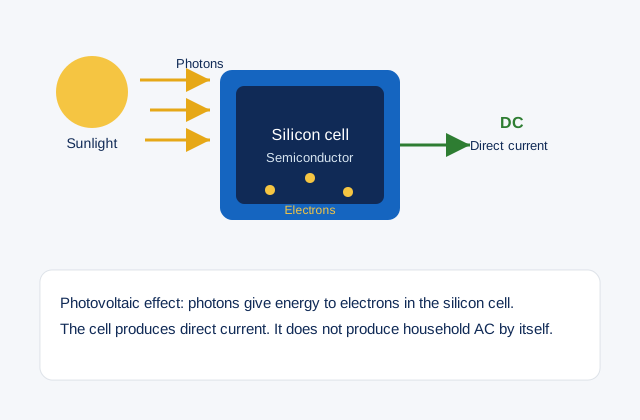
The silicon cell is built so that photons in sunlight give energy to electrons in the semiconductor.
That movement creates an electrical potential inside the cell. When the cell is connected to an electrical circuit, an electric current flows. The electricity produced from sunlight is direct current, DC.
The whole path from sunlight to the home
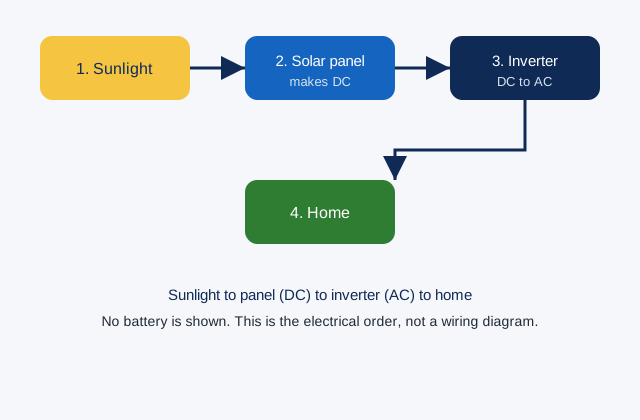
1. Sunlight
Light from the sun falls on the solar panel. The photovoltaic cells in the panel receive that light energy.
2. DC electricity
The photovoltaic effect produces current in the cells. The electricity from a solar panel is direct current.
3. Solar inverter
The solar inverter changes that DC electricity into alternating current, AC. Homes and the grid use AC.
4. Use in the building
AC from the inverter can run fans, lights, a television, a fridge, and other appliances. The panel does not run those appliances by itself.
The order from sunlight to the home
How an on-grid solar system works
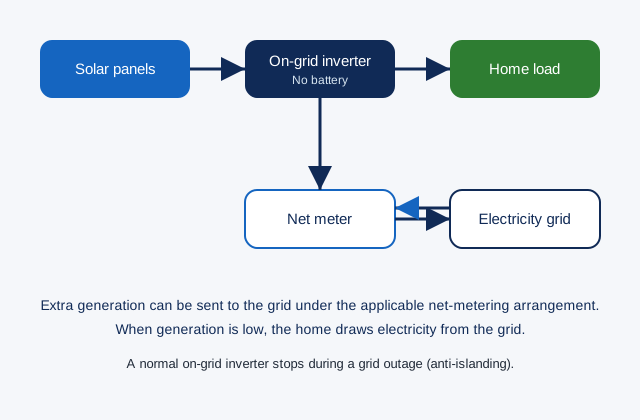
An on-grid solar system stays connected to the electricity grid. Its main parts are the solar panels, an on-grid inverter, and, where it applies, a net-metering arrangement.
When solar generation is higher than the home needs, the surplus can be sent to the grid through the applicable net-metering arrangement. When generation is lower, the home draws electricity from the grid as needed.
A simple on-grid arrangement
Does an on-grid system need a battery?
A normal on-grid solar system does not need a battery. The panels make DC during the day, the inverter turns it into AC, and the grid covers a shortfall or receives surplus generation.
Anti-islanding protection
A normal on-grid inverter stops producing electricity when the grid supply fails. That safety behaviour is called anti-islanding protection. Backup during an outage needs a hybrid system or another arrangement built for that purpose. This page is not that design.
How much electricity a solar panel makes
Output is not a fixed number. It depends on the points below.
Capacity and sunlight
Panel capacity, the strength of the sunlight, and the hours of sun all change the output.
Direction, tilt, and shade
Direction, tilt, and shade decide how much light reaches the glass.
Cleaning, temperature, and efficiency
Cleaning, temperature, and the efficiency of the inverter and the rest of the system also change production.
An example, without a promise
A 3 kW solar system can make several units a day in favourable conditions. Actual production differs with weather, place, and the installation. This page does not guarantee a number of units.
Why people consider solar
A chance to lower the bill
There is a chance of a lower electricity bill, depending on use and tariff. It is not a fixed saving for every home.
Applicable assistance
Eligible household consumers may be able to use government assistance where the rules apply. Confirm the amount and eligibility from the official source. This page states no amount.
No battery in a normal on-grid system
A normal on-grid system runs without a battery. Outage backup is not part of it.
Cleaner energy over time
It is cleaner energy. With suitable quality and installation, a system can keep producing for a long time. The period depends on the equipment and on maintenance.
What size should a home consider?
These points have to be assessed before a capacity is chosen. This page does not set a kilowatt figure.
Bill and use
Look at the monthly electricity bill and daily use.
The roof
Look at the free roof area, the sun, and the shade.
Later demand
Electricity needed later can also change the size.
In short
A solar panel turns sunlight into DC electricity through the photovoltaic effect. The inverter turns that electricity into AC, which can be used in a home, a shop, and other places.
Solar energy is an important way to meet energy needs more cleanly and more durably. Before treating a roof as a source of electricity, have the bill, the roof, and the connection reviewed.
Anvi Solar
Anvi Solar helps homes and businesses understand rooftop on-grid solar, arrange a site survey, and choose a suitable system. The service area is Indore, Dewas, Pithampur, Dhar, and nearby. Clean Energy, Brighter Tomorrow.
Where to read further
Common questions
Which principle makes a solar panel produce electricity?
A solar panel works by the photovoltaic effect.
Does a solar panel make AC or DC?
A solar panel makes DC electricity directly. The solar inverter turns it into AC electricity.
Does a solar panel work when it is cloudy?
Yes. It can still make electricity under cloud, but output falls because less sunlight reaches the cells.
Does a solar panel make electricity at night?
No. A normal photovoltaic panel needs sunlight to make electricity.
Does an on-grid solar system need a battery?
No. A normal on-grid solar system does not need a battery.
Does on-grid solar keep running when the grid is off?
A normal on-grid inverter shuts down when the grid fails, because of anti-islanding protection.
Related guides
- Solar panel technologyCells, module types, efficiency, heat, degradation, and why DCR matters for the central scheme.
- Solar inverter guideThe inverter turns panel current into household current and decides what happens when the grid fails.
- Solar structure and mountingThe structure holds the modules to the roof. Its size is an engineering result, not a catalogue guess.
Ready to Explore Solar Energy?
Speak with Anvi Solar about rooftop solar for your home or business.